
Anime High School RP Combat Guide: Fight Flow, Safe Zones, Stamina and Styles
How fighting works in Anime High School RP: where PvP is allowed, the full fight loop, safe-zone healing and escapes, and what stamina and combat Styles are confirmed to do.
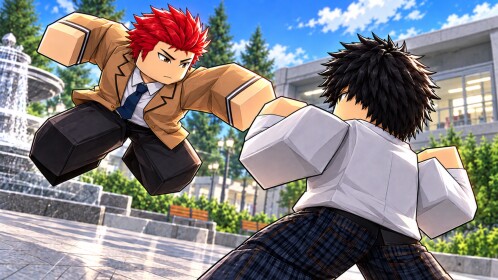
Fighting in Anime High School RP is always-on player-versus-player brawling: there is no setting that turns PvP off, and combat only works outside designated safe zones. The core loop is simple — walk up to another student, hit them, watch the HP bars drop, chase or flee, and duck into a safe zone to heal or end a pursuit. One player put it as plainly as it plays: "the game is pretty easy to get the hang of. You just have to like fight people like this."
Three things matter before your first fight: safe zones (they block attacks, heal you, and can break a chase), the HP bar turning yellow when you are low, and two confirmed constraint systems — stamina and combat Styles — whose exact in-fight effects are not documented yet.
Where fighting works: safe zones
Attacks simply do not land inside safe zones, which is how you can recognize them:
| Confirmed safe zone | What happens inside |
|---|---|
| Indoor basketball courts | Punches don't connect — "you can't punch in the basketball courts because it's actually a safe zone" |
| A room inside the school | Combat inputs do nothing; "it only works outside. Like that, we can fight other players" |
These two locations are the ones verified in gameplay, and the full set of safe zones on the map hasn't been mapped. Note there is also a second basketball court outside the school — it was not confirmed as a safe zone, only the indoor one was. Until more areas are confirmed, treat the indoor courts and the school room as your known ground, and test any new area before assuming it is fightable or safe.
The fight loop, start to finish
- Pick a target outside a safe zone. Combat inputs are dead inside safe zones, so step out first. Experienced players deliberately pick weak opponents — "Let's look for a low level one first" — though bystanders treat that as poor sportsmanship: "Don't just pick on low levels." Player levels visibly exist, but how they affect fight outcomes is not documented.
- Start the fight by hitting the other player. There is no challenge menu — you attack directly with punches: "we have to hit him." Once the punches start, you have more than one move: a heavy punch, blocking incoming hits, and dodging or dashing. One guide's advice: dash as you strike and block when pressured.
- Watch the HP bar. It drops as you take hits and visibly turns yellow when a fighter is low: "the HP is down to yellow" / "It's yellow already." That color change is your cue that the fight is about to end one way or the other.
- Fleeing and chases are part of the fight. A losing player can run away mid-fight and the winner chases: "See, he ran away" / "Oh, getting chased." This is the main movement pattern during combat — victim runs, chaser follows, and the chase ends at a safe-zone boundary when the runner is allowed in (see the safe-zone notes below).
- The fight ends when one side loses ("Oh no, I lost") — in a knockout, not a death. The loser gets carried off by other players: "this happens when you get knocked out. You're going to be getting carried." Knockouts are also a tracked result: the game surfaces a "Most knockouts" leaderboard, where one player seen on it had 19,000 knockouts.
What follows the carry — respawn flow, penalties, anything dropped — is not shown in any footage so far, so don't count on a specific consequence either way. The one related observation is a beaten player unable to respawn mid-fight, noted in the safe-zone section below.
Healing and escaping through safe zones
Safe zones are not just no-fight areas; they are your recovery points.
- Healing: when your HP turns yellow mid-fight, retreat into one and recover — "we have to heal up in here. Keep it safe."
- Escaping a chase: a safe zone can end a pursuit outright, because the attacker can't continue the fight inside: "Wow, it's safe here. It's dangerous outside... Look, I can escape here. Pull. Safe."
- But entry isn't guaranteed: in one recorded fight, the player being punched couldn't get into the safe zone at all — even trying to glitch through the entrance ("I can't enter the safe zone... it didn't let me do that") — and couldn't respawn either, so the attacker was free to keep hitting. Nothing in the footage shows what decides between a granted escape and a blocked one, so treat the nearest safe zone as your best retreat option rather than a guaranteed exit.
Practical takeaway: know where your nearest safe zone is before you pick a fight, because both confirmed safe zones are indoors (the courts and the school room) and everything between them is contested ground.
Controls and settings
The settings menu lists the combat-related options in one place: "we have combat volume, everything, the rooms, controls, you can see it all here." Two facts from it matter for fighting:
- PvP cannot be disabled. The player who opened settings specifically looking for a way to turn fighting off found no such option — combat is always on in fightable areas.
- Combat is triggered from the keyboard, but the exact binds are not reliably readable from gameplay footage, so open the Controls list in settings and read your keys there rather than trusting transcribed ones.
Stamina: confirmed, but under-documented
Stamina is a real constraint on fights and chases — the game's own description warns players to "watch your stamina if a friendly schoolyard fight turns into a full-blown chase." That warning is also the confirmed scope: stamina demonstrably matters when a casual scrap escalates into a campus-wide pursuit. What no source has shown yet: which actions drain it, how it refills, and what you can or cannot do when it empties. Until that is documented, don't assume sprinting or punching has a specific stamina cost. See Anime High School RP stamina for the dedicated breakdown.
Height and reach
Your character's height, which rerolls can change, is a combat attribute rather than pure cosmetics: taller characters have greater melee reach and damage, while shorter characters have quicker punch animations. In practice that means a taller fighter can hit you from just outside your own reach. It's also why one guide's author rerolls specifically for extra height — though the exact height targets they aim for are personal preference, not an established rule.
Combat Styles: where they fit
Combat Styles are a real feature with rarity tiers, offered in the in-game shop: "you can get VIP. You can get some fighting styles and whatnot." The latest update added "a new Mythic fighting Style called Togi," and fighting-minded players are invited to "experiment with different combat Styles, including the new Mythic Togi."
Acquisition is only half-shown, though, and one popular claim about it stays unconfirmed. The shop lists fighting styles for sale, but no footage follows through to a purchase. Rerolls are a second candidate route, and the only source for it hedges both times it comes up: "we could use these rerolls to get some fighting styles, I'm pretty sure." Against that, the game's own overview describes Rerolls purely as appearance customization ("You can change your appearance through Rerolls or by spending Yen"), and neither route is shown producing a Style on screen — so treat the reroll-to-Styles link as unconfirmed.
What is not documented: what an equipped Style actually changes in a fight — moveset, damage, range, speed, or stamina use — or how you select, equip, and switch Styles in the menus. No footage shows a Style being equipped, switched, or used in combat, so treat Togi's Mythic label as a rarity tier, not a promise of specific combat power. Style-by-style findings are collected in the Anime High School RP combat styles guide.
Checks you can reproduce in one session
Every base mechanic above is observable in a single visit, which makes them easy to re-verify yourself:
- Try punching inside the indoor basketball courts — nothing connects. Step outside and it does.
- Enter the school room identified as a safe zone and try your combat keys — dead inside, working outside.
- Get into a fight and watch for the HP bar turning yellow at low health.
- Run from a losing position and see whether the chase stops at the safe-zone boundary — and whether you're actually let in to heal.
- Open Settings to confirm there is no PvP toggle, and read your combat keys from the Controls list.
- Check the "Most knockouts" leaderboard to see the tracked fight results.
These observations come from gameplay recorded in October 2026, close to the game's release. Controls, safe-zone placement, and the stamina and Style systems are exactly the things most likely to change in balance or mechanic updates, so re-check them against current footage or your own session before relying on them.
Related Guides
Combat Styles
Every Anime High School RP combat Style with its reroll odds, plus how to get a new Style through Stats-profile rerolls or permanent gamepass unlocks.
Stamina
Know the confirmed stamina rule: watch it the moment a schoolyard fight turns into a chase.
How to Play
Walk your first campus session: claim rewards, reroll your student, fight outside safe zones, and heal inside them.